
Transformations of Graphs
Reflections
|
We will discuss two types of reflections: reflections across the x-axis and reflections across the y-axis. Reflections Across the x-Axis To visualize a reflection across the x-axis, imagine the graph that would result from folding the base graph along the x-axis. Symbolically, we define reflections across the x-axis as follows:
In other words, all of the portions of the graph above the x-axis will be reflected to the corresponding position below the x-axis, while all of the portions of the graph below the x-axis will be reflected above the x-axis. Of course, x-intercepts will remain unchanged under this type of reflection Examples of Reflections Across the x-Axis Consider the following base functions,
The graphical representation of function (1), f (x), is a parabola shifted 9 units down with respect to the base function y = x2. What do you suppose the graph of y1(x) = -f (x) looks like? Using the definition of f (x), we can write y1(x) as, y1(x) = -f (x) = -(x2-9) = -x2 + 9. Based on the definition of reflection across the x-axis, the graph of y1(x) should look like the graph of f (x), reflected across the x-axis. Take a look at the graphs of f (x) and y1(x).
Function (2), g(x), is an absolute value function. What would the graph of y2(x) = -g(x) look like? Using our knowledge of reflections across the x-axis, the graph of y2(x) should look like the base graph g(x) reflected across the x-axis. To check this, we can write y2(x) as, y2(x) = -g(x) = -(|x| + 1) = - |x| -1 , construct a table of values, and plot the graph of the new function. As you can see, the graph of y2(x) is in fact the base graph g(x) reflected across the x-axis.
Reflections Across the y-Axis You can visualize a reflection across the y-axis by imagining the graph that would result from folding the base graph along the y-axis. Symbolically, we define reflections across the y-axis as follows:
In other words, all of the portions of the graph to the left of the y-axis will be reflected to the corresponding position to the right of the y-axis, while all of the portions of the graph to the right of y-axis will be reflected to the corresponding positions to the left of the y-axis. Of course, y-intercepts will remain unchanged under this type of reflection. Examples of Reflections Across the y-Axis Consider the following base functions,
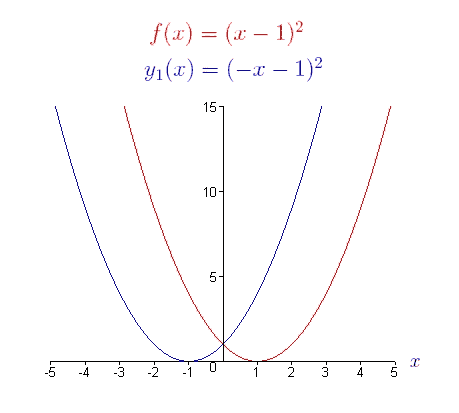
The graphical representation of function (1), f (x), is a parabola shifted 1 unit to the right. What do you suppose the graph of y1(x) = f (-x) looks like? Using the definition of f (x), we can write y1(x) as, y1(x) = f (-x) = (-x -1)2 = x2 + 2x +1 . Based on the definition of reflection across the y-axis, the graph of y1(x) should look like the graph of f (x), reflected across the y-axis. Take a look at the graphs of f (x) and y1(x).
Function (2), g(x), is a cubic function. What would the graph of y2(x) = g(-x) look like? Using our knowledge of reflections across the y-axis, the graph of y2(x) should look like the base graph g(x) reflected across the y-axis. To check this, we can write y2(x) as, y2(x) = g(-x) = (-x)3 - (-x)2 -4(-x) + 4 = -x3 + x2 + 4x + 4, construct a table of values, and plot the graph of the new function. As you can see, the graph of y2(x) is in fact the base graph g(x) reflected across the y-axis.
***** Now try some problems that test your knowledge of graphical transformations |



The Biology Project > Biomath > Transformations > Reflections
Department of Biochemistry and Molecular Biophysics
The University of Arizona
January 2006
Contact the Development Team
http://www.biology.arizona.edu
All contents copyright © 2006. All rights reserved.